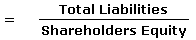
What Does Leverage Mean?
1. The use of various financial instruments or borrowed capital, such as margin, to increase the potential return of an investment.
2. The amount of debt used to finance a firm's assets. A firm with significantly more debt than equity is considered to be highly leveraged.
Leverage is most commonly used in real estate transactions through the use of mortgages to purchase a home.
1. The use of various financial instruments or borrowed capital, such as margin, to increase the potential return of an investment.
2. The amount of debt used to finance a firm's assets. A firm with significantly more debt than equity is considered to be highly leveraged.
Leverage is most commonly used in real estate transactions through the use of mortgages to purchase a home.
1. Leverage can be created through options, futures, margin and other financial instruments. For example, say you have $1,000 to invest. This amount could be invested in 10 shares of Microsoft stock, but to increase leverage, you could invest the $1,000 in five options contracts. You would then control 500 shares instead of just 10.
2. Most companies use debt to finance operations. By doing so, a company increases its leverage because it can invest in business operations without increasing its equity. For example, if a company formed with an investment of $5 million from investors, the equity in the company is $5 million - this is the money the company uses to operate. If the company uses debt financing by borrowing $20 million, the company now has $25 million to invest in business operations and more opportunity to increase value for shareholders.
Leverage helps both the investor and the firm to invest or operate. However, it comes with greater risk. If an investor uses leverage to make an investment and the investment moves against the investor, his or her loss is much greater than it would've been if the investment had not been leveraged - leverage magnifies both gains and losses. In the business world, a company can use leverage to try to generate shareholder wealth, but if it fails to do so, the interest expense and credit risk of default destroys shareholder value.
2. Most companies use debt to finance operations. By doing so, a company increases its leverage because it can invest in business operations without increasing its equity. For example, if a company formed with an investment of $5 million from investors, the equity in the company is $5 million - this is the money the company uses to operate. If the company uses debt financing by borrowing $20 million, the company now has $25 million to invest in business operations and more opportunity to increase value for shareholders.
Leverage helps both the investor and the firm to invest or operate. However, it comes with greater risk. If an investor uses leverage to make an investment and the investment moves against the investor, his or her loss is much greater than it would've been if the investment had not been leveraged - leverage magnifies both gains and losses. In the business world, a company can use leverage to try to generate shareholder wealth, but if it fails to do so, the interest expense and credit risk of default destroys shareholder value.